|
AUTHOR OF
DEEP SURVIVAL: WHO LIVES, WHO DIES, AND WHY |
|
COMING IN 2027
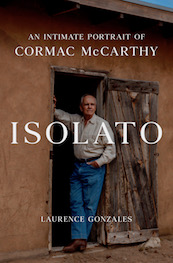
ISOLATO AN INTIMATE PORTRAIT OF CORMAC McCARTHY FROM RANDOM HOUSE (CROWN)
EXCERPT FROM ISOLATO: John Hersey, who had won a Pulitzer Prize for his first novel and was chairman of the American Academy of Arts and Letters, was one of Cormac's earliest supporters, responsible at least in part for getting him his first grant, the traveling fellowship from that academy, called the Rome Award. Hersey was also on the committee of the Rockefeller Foundation. Along with the advance from Random House, this represented a temporary end to Cormac’s poverty and allowed him to travel in reasonable comfort in the summer of 1965. The Cunard Line’s Saxonia class ocean liner Sylvania had come from England, spent three days in New York, and was returning to London by way of Ireland. Cormac boarded in New York and quickly learned that, despite the pleasant accommodations, boredom was the default state on a ship in the middle of the ocean. He had little to do except read and eat and then drink and dance the evenings away. Of course, he had his portable typewriter with him, by then the type of Lettera 32 that had come out from Olivetti the previous year. He would use that typewriter, or an identical one, for the rest of his life. He also had a draft of his second novel, Outer Dark, and 70 pages of Suttree to work on. But he took full advantage of the dining and dancing. A cabaret act called the Poppets served as entertainment. Annie DeLisle told me that it consisted of her and her girlfriend Nicky Banks backed by a pianist named Allen Tirrel. One evening DeLisle, who at age twenty-four was a spritely ballet dancer, glowing with youth and energy, noticed Cormac, wearing a beige pinstriped suit, twirling a young lady out on the dance floor. "And I just fell in love," she said. "I went over and said, 'Could I have the next dance?' He smiled. He didn't say anything. He put his arms around me and pulled me close to him. And it was dynamite. Amazing. The way a perfect love affair should begin. It's the most romantic story in the world. We met in the middle of the Atlantic Ocean on a ship called Sylvania. It was a five-day crossing." At that time, Cormac had black hair, luxurious eyebrows, a high forehead and a handsome face. He was not a tall man, but tall enough for Annie, who was very much the pixie. As always, he was perfectly dressed every night. Through much of his life, Cormac worked out at a gymnasium, often every day. He admitted that he did it specifically to make himself attractive to women. He also learned to dance exceptionally well and combined those skills in the deliberate seduction of the women he chose. Or those who chose him. He had all the moves when he asked a woman to dance, or as in this case, the other way around. He knew them by heart in the literal sense. He placed one of his large, strong hands in the hollow at the small of Annie’s back and drew her into him. Sinking into that smooth, swift move, she saw the handsome face, the glittering eyes, the white teeth, the heavy brow, the black hair, and her interior turned to butter. She felt the rib-rush of endorphins in her middle and was lost to him. She never recovered. "We danced through the whole trip," DeLisle said, "and we laughed and went to bed together—just had a fabulous time." The ship was not a luxury liner. It featured murals of agricultural scenes and mirrors with filigreed frames. The bar was painted brown, not a typically festive color. The food was pedestrian, which would not have bothered Cormac. But nothing mattered, because they were both smacked down by the spiking fever of love at first sight. Annie for her part was a very serious artist. She began studying ballet at the age of six. She qualified through the Royal Academy of Ballet and entered the Southampton School of Ballet at the age of 13. By 17 she was a professional. After teaming up with Nicky Banks, they worked all over the world, including Africa and Asia. Once she had moved to Tennessee she played leading roles in the Maryville-Alcoa Ballet, including "The Nutcrakcer," Sleeping Beauty," and "Swan Lake." She was far more than a Poppet. Annie was bound for home in South Hampton, and Cormac was booked to Ireland. "That night we stayed up all night," she said, her voice going far away and cracking now more than half a century later. "And then we were out on the deck at sunrise as we came into Ireland, and the mist was coming off the water. And the huge rocks coming out of the water all backlit in the morning, and then the tender boat came out to load the passengers who were leaving, and he got on, and then he was just gone in the mist." Cormac visited some relations in Ireland and saw the typical sights. His maternal grandmother was from a town called Cork, so he stopped there. He wrote a postcard to his childhood friend Jim Long. "I Kissed the Blarney Stone and all," he said. He drank and listened to Irish music at the pubs and even sang some mountain songs from Tennessee for the locals. Cormac also wrote to Annie every day, sometimes on scraps of paper, napkins, the backs of envelopes. His seduction was frenzied, aggressive, desperate. When he left Ireland, he went straight to England to join her. They traveled around while she worked as an entertainer, Cormac trailing along and sitting in the audience to applaud her performances. After six months he proposed to her, and in 1966, nine months after they met, they were married in the 900-year-old church of St. Andrew's in the town of Hamble-le-Rice in Hampshire. Nicky, Annie's partner, was her maid of honor. She would later marry their pianist, Allen Tirrel. |